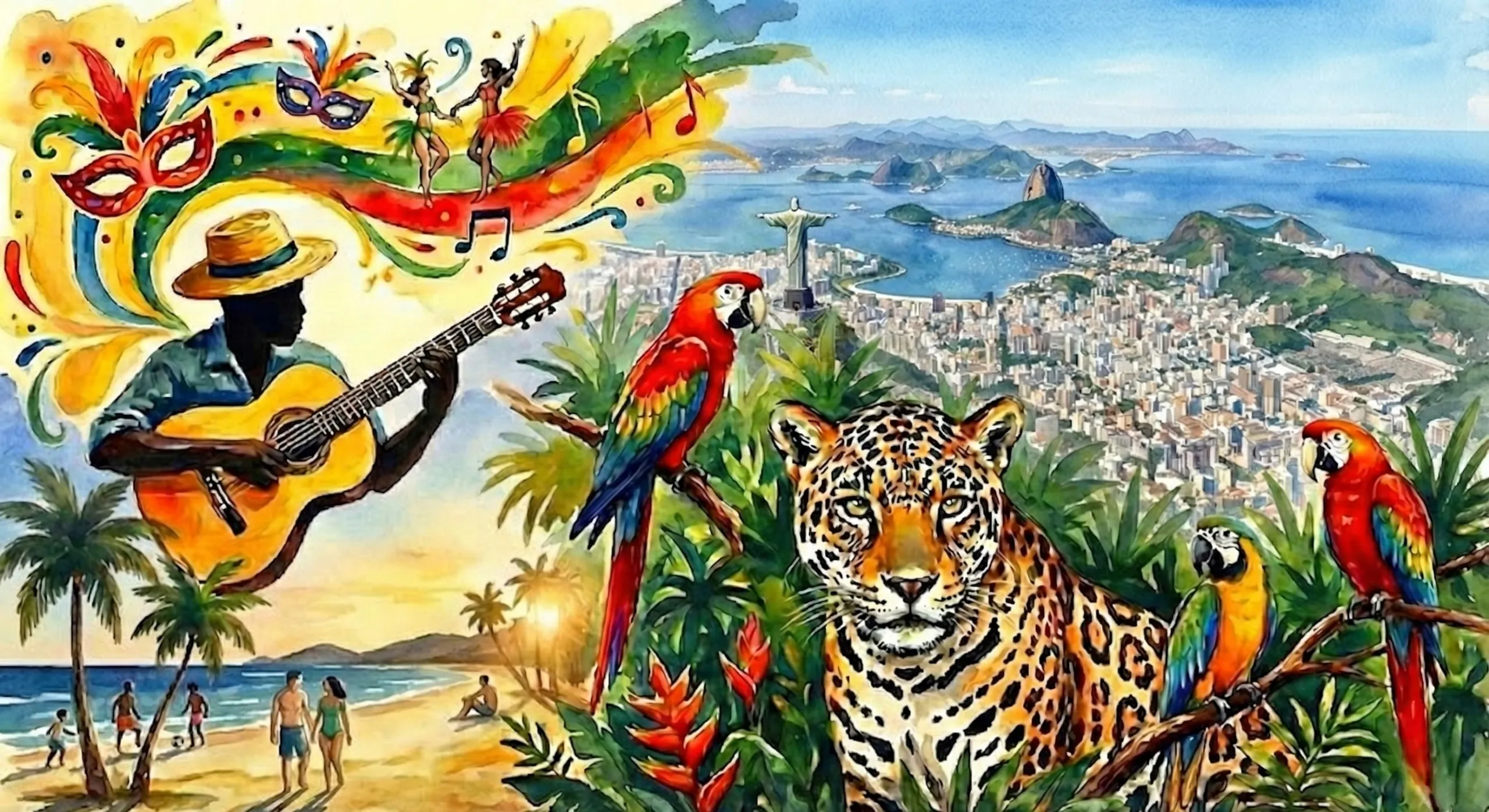
Brazil
This is the pilot in a project to map the world’s impact economy.
Portuguese
Official language
212.0 million
Population
$2.29T
GDP (in USD)
National currency: Real (BRL)
South America
World Region
0.786
HDI
The Human Development Index measures key dimensions of human development such as health, longevity, education, and standard of living.
• Below 0.55 = Low
• 0.55 – 0.69 = Medium
• 0.70 – 0.79 = High
• 0.8+ = Very High
Age Groups
• 15-24: 16.06%
• 25-54: 43.83%
• 55-64: 9.78%
• 65+: 9.21%
*2020 estimates
Fertility Rate
The average number of children born to a woman over her lifetime.
2.1 is the "replacement level" that keeps a population stable (the extra ~0.1 accounting for child mortality).
• Above 2.1 = Growth
• Below 2.1 = Decrease
(not accounting for migration)
Urbanization
88%
Largest metro: São Paulo (~22 million metro)
Tradition
Brazil is among the most diverse, vibrant countries in the world. Its traditions are anchored in European Catholic society, from the country’s origins as a former Portuguese colony, intertwined with Indigenous and African influences in a coastal, tropical landscape. Today’s Brazil reflects a wider range of world cultures, notably from Japan, Italy, and other European countries.
Brazilian traditions manifest with festivals like Festa Junina (or June Festival, celebrating rural culture with bonfires, folk dances, and traditional foods), Carnaval, and many Catholic and national holidays.9 10 11 12
Modern Day
Modern Brazil is an economic and digital force, maintaining its old economy (built on commodities) alongside a newer reality of business, finance, and tech innovation. Especially in major cities like Rio de Janeiro and São Paulo (the financial heart of Latin America) younger generations are embracing global tech trends and startup culture.
The country consistently ranks highly in global surveys for digital adoption and social media use. The digital shift has shaped aspects of society from Brazil’s increasingly polarized political landscape to its growing “creative economy”.14 15 16 17 18
The Arts
Brazilian arts are dynamic and expressive. Music is the heartbeat, with genres from the globally recognized Bossa Nova and Samba to domestic powerhouses like classic MPB (música popular brasileira), rural-derived Sertanejo, and the urban sounds of pop, hip-hop, or funk carioca.
Brazil also has unique cultures of literature, film, visual art, architecture, and more. In 1922, A Semana da Arte Moderna (Modern Art Week) declared a uniquely Brazilian identity, blending diverse influences and breaking from European-derived “high art”. This moment paved the way for subsequent generations of artists to express their complete cultural identities.19 20 21 9 22
Belief Systems
Religion is a strong element in Brazilian culture. Brazil has the world’s largest Catholic population, making up 56.7% (120.2 million) of its people. Another 26.9% identify with other Christian religions, 1.8% with Spiritism, 1% with the African Candomblé and Umbanda, and 9.3% as non-religious. Catholicism and Spiritism have declined, and the other categories grew between 2010 and 2022.
While Christianity is predominant, the landscape is flavored by “double belonging” where some attend both Catholic mass and Afro-Brazilian rituals. African and indigenous beliefs also contribute to the country’s folklore and traditions.23 24 25 26
Food
Brazilian cuisine is a mosaic of indigenous, African, and European recipes built on a foundation of rice, beans, and cassava (a.k.a. yuca or mandioca, which began as an indigenous staple). The coastal state of Bahia is famed for its seafood and Afro-Brazilian flavors. Italian and Japanese influences are strong in the region around São Paulo.
Churrasco (barbecue), originating from Brazil’s South, is popular nationwide. Pão de Queijo (cheese bread), from the state of Minas Gerais, is also ubiquitous. Açaí, a native superfood berry, is world famous. Sugar, coffee, and other major crops are important both domestically and as exports.9 27 28 30
Community
Brazilian community life is defined by family-centered vibrancy and a social “glue” of warmth and openness. The energy of Brazilian society can be understood in part through the concepts of cordialidade (leading from the heart) and jeitinho (the “little way” of problem-solving through personal connections). These traits foster a strong social dynamic, and they can blur the lines between formal and informal matters.
Football (soccer) is a unifier. Neighborhoods often foster tight-knit communities, especially in smaller towns and peripheral urban areas.31 32 11 33 34
Challenges
Brazil is often considered a “developing” country, yet it also has a strong and undeniable foothold in the “developed” world. This is an interesting dynamic in the 21st century, as the world has begun to see the negative effects of development. Often in “developing” countries, many aim to pursue modernization full-force while others aim to modernize in a way that avoids social and environmental pitfalls. This tension presents a central cultural challenge.
In addition, Brazil continues to exist with extreme income inequality and structural racism, two forces that are deeply intertwined.35 36 37 39
Biomes
Brazil’s six key biomes form an interconnected system. The Amazon Rainforest, covering half of the country, is a crucial home for biodiversity and a global climate regulator.
The Atlantic Forest is a biodiverse coastal ecosystem now containing most of Brazil’s population, though about 88% has been lost to human activity. The Cerrado (savanna) contains the headwaters of several South American river basins. The Caatinga (a semi-arid region in Brazil’s northeast), Pampa (grasslands in the south), and Pantanal (wetlands in the center-west) together cover roughly 14% of the country.40 41 42 43 44
Biodiversity
Brazil is the most biodiverse country on Earth, home to an estimated 15–20% of the world’s biodiversity. Brazil is home to at least 43,020 plant species and an astonishing 103,870 animal species. The Amazon is renowned for jaguars, anacondas, ancient trees, and vast insect diversity. The Pantanal is a sanctuary for caimans, capybaras, and large populations of waterfowl.
The nation is in a race between cataloging this biodiversity (as biologists continue to find new species) and losing it to habitat destruction. The Atlantic Forest (Mata Atlântica) has the most endangered species, including over 2,800 animal species and 3,200 tree species.45 46 47 48 49
Human Dynamics
Human effects on Brazil’s natural ecosystems are an evolving interplay of agricultural expansion, industrial development, and preservation. Past and current deforestation, largely in the Mata Atlântica and Amazon, has been driven by “slash and burn” extraction.
Yet there is growing global pressure and domestic consciousness around ecosystem conservation. Modern nature-based and forest-positive economic models (like açaí, rubber cultivation, carbon credit creation, sustainable agriculture, and many other business models) offer models for value creation without destruction.50 51 52 53 54
Preservation
Brazil has one of the world’s most rigorous environmental legal frameworks, with laws like its Forest Code and agencies like IBAMA and ICMBio. Legislation, while often challenged, exists to regulate deforestation and pollution.
Brazil’s public has seen growing ecological awareness, and lawmakers have created a network of protected areas, including national parks, ecological stations, and Indigenous territories. Efforts to combat illegal logging and promote sustainable agriculture, alongside international partnerships for climate change mitigation and biodiversity conservation, have seen significant successes.55 56 57 53
Challenges
Contrasting impressive preservation efforts, the “arc of deforestation” represents an existential risk to Brazil’s ecosystems. Expansion of cattle ranching, crop cultivation, and illegal mining is pushing the Amazon toward a potential savannization tipping point, where forest loss and warming could irreversibly disrupt regional rainfall systems.
This local ecological breakdown would have consequences in Brazil, weakening the “flying rivers” that influence South American rainfall patterns, and globally, accelerating climate change through both carbon release and the loss of a major carbon sink.40 59 60 61
Livelihood
Income inequality is stark in Brazil, with a World Bank Gini index of 51.6 (among the highest). A formal labor market sustains the middle and upper classes, yet millions working in Brazil’s informal economy remain in poverty. Programs like Bolsa Família (while politically controversial) help low-income families regardless of formal employment. Other labor laws benefit only those in the formal economy.
The relationship between wages and cost of living creates a divide in purchasing power. Smaller incomes are absorbed by basic necessities, so discretionary goods, quality education, private healthcare, and other comforts are largely confined to middle- and high-income groups.64 65 66 67
Business
Brazil’s business ecosystem grew in the 20th century with world-leading exports of soy, sugar, beef, and coffee; extractive exports like oil, iron ore, and bauxite; and manufactured goods like automobiles and machinery.
Today, that legacy is complemented by a growing “new economy” that features one of the world’s most advanced fintech and startup ecosystems, as well as higher-value extensions of established sectors like deep-water oil extraction and aerospace manufacturing. Brazil’s service sector, including banking, retail, and tourism, remains the largest contributor to GDP.67 68 69 70
Finance
Brazil’s financial system is modern, institutionally dense, and tightly regulated, shaped by the stabilization that followed the Plano Real (1994), which ended decades of chronic inflation. Since then, the Central Bank has kept relatively high interest rates to anchor currency and price stability.
São Paulo’s Faria Lima—Brazil’s Wall Street and home to Latin America’s biggest stock exchange, the B3—is a hub for banking, asset management, private equity, and global markets. Brazil is widely seen as a high-liquidity emerging market, albeit one with some macroeconomic volatility and political risk.71 72 73 74 75 76
NGOs
Brazil’s third sector, formally organized as Organizações da Sociedade Civil (OSCs), plays a central role in shaping the country’s social and environmental landscape. OSCs operate across education, public health, community development, human rights, and ecosystem protection, often in territories where state capacity and market incentives are limited.
From forest conservation to favela-based social programs, OSCs help sustain essential services, mobilize local networks, and stabilize communities during crises, exerting influence not only through scale of capital, but through reach, trust, and institutional integration.77 79
Impact Enterprise
Brazil has one of the most dynamic impact-enterprise ecosystems of the world’s emerging markets, shaped by unmet social needs, deep capital markets, and regulation that support hybrid business models.
The country hosts over 200 Certified B Corporations, alongside a broader set of mission-driven startups promoting financial inclusion, health, education, sustainable agriculture, and climate solutions. Impact enterprises benefit from Brazil’s large scale, where they can reach millions domestically while engaging global markets through climate finance, ESG supply chains, and international capital flows.85 86 87
Impact Investment
On the global impact investing stage, Latin America remains a relatively small market: the GIIN estimates the region holds roughly 1% of global impact assets under management. Within that picture, Brazil represents the largest share, with impact AUM estimated at USD$ 3.5B, reflecting its scale, capital depth, and biodiversity endowment. This contrast, between LatAm’s small share of capital and Brazil’s developing impact business ecosystem, shapes Brazil’s position within the global impact investing landscape.
Within Brazil itself, impact investment is driven by local fund managers and an expanding web of relationships with international investors, using blended finance, climate capital, and inclusion strategies to channel capital into high-impact, scalable ventures.92 93 94 95 96
Opportunities & Risks
Brazil’s economy is at a structural turning point, combining the scale of a large emerging market with pressures to modernize. Its diversified base (agribusiness, mining, energy, manufacturing, and services) shows opportunities for productivity gains, infrastructure investment, and renewed global capital interest. At the same time, climate, bio-economy, and digital-finance themes are becoming more economically material, shaping where new investment and innovation concentrate.
These opportunities sit alongside enduring risks: fragile public finances, high interest rates, complex regulation, infrastructure gaps, and the growing economic threat posed by climate change to agriculture and energy systems.102 103 104 105
Political Structure
Brazil is a federal presidential republic governed under its 1988 Constitution, with executive, legislative, and judicial branches. The president leads the government, while lawmaking authority rests with a National Congress composed of many parties.
Though presidential politics looks binary in the media, the legislature remains multiparty, and the president must pursue “coalition building” to govern. Brazil’s federal structure, including 26 states and a Federal District, grants autonomy at state and local levels. The judiciary helps enforce constitutional order and resolve disputes.109 110 111 112
Civil Liberties
Brazil’s 1988 Constitution guarantees liberties such as free expression, assembly, religious freedom, due process, and social rights. These freedoms represent a sharp break from previous military-era practices.
In practice, many Brazilians experience an “implementation gap” with disproportionate exposure to police violence and incarceration, as well as intimidation by state and non-state actors targeting journalists, human-rights defenders, and environmental or Indigenous leaders. Amidst this dynamic, courts, civil society, and digital activism continue pushing constitutional rights from paper into lived reality.109 113 114
Geopolitics
Internationally, Brazil positions itself as a pragmatic middle power, defined by diplomacy, scale, economics, and coalition-building. Its foreign policy tradition emphasizes multilateralism, non-intervention, and dialogue across blocs, shaping its role in forums like the G20 and BRICS.
Brazil is Latin America’s largest economy and “the steward of the Amazon”, a role which has become leverage in climate and trade negotiations. This stance allows Brazil to be a bridge between “developed” and emerging economies, while pressing for greater influence in global politics.118 119 120 102
Infrastructure
Brazil’s infrastructure shows sharp contrasts. The country operates one of the world’s cleanest electricity systems, with renewables supplying the vast majority of power, while digital connectivity and payments infrastructure rank among the most advanced in emerging markets.
At the same time, physical logistics lag behind economic scale: freight transport remains heavily dependent on roads, rail and waterways are underdeveloped, and gaps in sanitation persist, especially in urban peripheries and rural areas. These imbalances influence Brazil’s competitiveness, social outcomes, and pace of long-term growth.103 121 102 122
Accountability
Brazil has strong formal mechanisms for accountability (such as transparency laws, independent oversight bodies, and a capable electoral system) yet faces challenges in enforcement. Recurring corruption scandals have created tensions between coalition-based governance and public accountability.
High-profile investigations have shown the state’s capacity to investigate elites, but also revealed vulnerabilities to politicization, uneven enforcement, and slow judicial processes. Accountability in Brazil remains functional, contested, and central to the political conversation.124 125 126 127
Cross-Sector Work
Cross-sector collaboration is a defining feature of Brazilian governance, particularly at the local level. Mechanisms like municipal policy councils involve civil society in decision-making, while public–private partnerships are central to infrastructure and service delivery.
These arrangements enable coordination across government, business, and NGOs. The catastrophic floods of 2024 in Rio Grande do Sul, for example, showed how networks can mobilize public agencies, local organizations, and private resources quickly, while also revealing ongoing challenges in coordination, accountability, and scale.129 102 130 131
Opportunities & Risks
Brazil’s governance system combines notable institutional strengths with persistent structural constraints. Democratic processes have proven resilient, supported by fast, credible elections, autonomous economic institutions, and broad social protections.
At the same time, governance capacity is strained by judicial delays, fragmented politics, and uneven government presence across regions. The central challenge is not in the formal structure, but in the execution, converting institutional strength into timely decisions, effective enforcement, and public trust amid recurring political polarization.133 76 102 128
National
Brazil’s national history has seen shifts in government and economic cycles that have reshaped power, land ownership, and social hierarchy. Portuguese colonization after 1500 began with a plantation economy, built largely on slavery, that exported sugar, gold, and later coffee.
Brazil’s independence in 1822 ushered in a constitutional monarchy, until a military coup created the First Republic in 1889. State power expanded in the 20th century through industry and military rule, leading to a dictatorship (1964-1988), until a new democratic constitution rewrote concepts of citizenship, federalism, and civil rights.10 134 135
Ancestral
Before 1500, Brazil’s land was home to millions of Indigenous people in diverse, sophisticated societies. Archaeology reveals advanced settlement patterns, agriculture, and environmental management across the Amazon and beyond.
On Marajó Island, the Marajoara culture built large earthen mounds, raised fields, and complex drainage systems. Elsewhere, Amazonian peoples engineered fertile soils (terra preta) and actively shaped forest ecosystems to sustain dense populations. Long marginalized in official histories, this ancestral past endures through Indigenous knowledge systems, land stewardship practices, and ongoing struggles for territorial recognition.137 138 139
Alternative
Brazil’s “textbook” history increasingly dovetails with alternative histories as information becomes democratized and more people deepen their understanding of stories like those of Indigenous and quilombo (descendants of escaped slaves) communities.
These alternate histories reveal patterns of power concentration, loyalty-based political networks, and repeated corruption crises; unequal access to land, education, and security; and the long suppression of Indigenous peoples through dispossession, violence, and contested recognition that continues today.10 134 141 142 109 143 144 145 146 147
Successes
Brazil’s history includes several successes that continue to shape its institutions and identity. The country has built a long-standing diplomatic tradition centered on peaceful negotiation and regional stability, avoided large-scale interstate conflict, and achieved a negotiated return to democracy in 1988 without civil war.
It also constructed ambitious social institutions—most notably the Unified Health System (SUS)—that expanded access to healthcare and reduced extreme deprivation, demonstrating a capacity to translate political change into lasting public infrastructure.135 152 153
Challenges
Brazil’s 500 years of national history is marked by obstacles. Extreme concentration of wealth and land (a legacy of the colonial era) continue to limit social mobility and political inclusion. Cycles of authoritarianism have disrupted democracy, while inflation and fiscal instability undermined long-term planning.
These patterns (perpetuated by the mixing of public and private interests, as well as uneven enforcement of the law) have produced an economy and political system prone to rupture, inequality, and, at times, slow institutional development.10 135 136
Snapshot
A snapshot of Brazil in the mid-2020s shows institutions stabilizing despite ongoing political polarization. Economic policy is focused on inflation control, fiscal credibility, and stimulation of investment (from both domestic and foreign investors).
Brazil’s scale, energy diversity, biodiversity, and emerging economy position it as a global partner in climate talks, energy transitioning, and economic development. The country’s near-term picture continues to show inequality, infrastructure gaps, and political tension, yet Brazil’s institutional capacity and global relevance create opportunity for the decade ahead.154 107 155 102
Roadmap Plans
The Brazilian government’s plans, on paper, largely outline sustainable development. However, in practice these plans face political and market pressures that pull implementation back toward “conventional” approaches.
Federal plans emphasize low-carbon reindustrialization and deforestation control, and development banks are channeling capital into sustainable biofuels, agritech, and infrastructure. At the same time, illegal mining, land clearing, and short-term growth incentives continue to compete with these agendas. The road ahead will depend on enforcement, capital discipline, and political will.156 157 158 159
Projections
Brazil’s economic forecasts cluster around steady but not-astronomical growth, dependent on fiscal discipline and global conditions. Population aging and decrease (with younger generations smaller than older generations) is expected to accelerate in the 2030s, raising demands on pensions, healthcare, and productivity (though labor shortages could be offset by productivity increases from AI and robotics).
Climate models project higher temperatures and more frequent extremes throughout the country, with implications for agriculture, infrastructure, water systems, and internal migration.160 161 162 163
Obstacles
By and large, obstacles to Brazil’s momentum are less due to a lack of potential and more about long-standing structural frictions. Broad economic disparity, uneven education, and infrastructure gaps can limit growth and competitiveness.
A complex tax and regulatory environment (though partly intended to manage risk) raises costs for firms and discourages long-term investment. These obstacles persist across political cycles, therefore the central challenges to sustained development, rather than leadership change, include socioeconomic inclusion, improved policy execution, and institutional efficiency.102 164 165 166
Tipping Point Risks
The largest tipping-point risk in Brazil (and one of the largest in the world) is the decimation of the Amazon, where deforestation and warming could weaken rainfall that supports agriculture and energy, as well as carbon cycles that affect the planetary climate.
Other risks include political polarization, which could erode trust in democracy, making laws harder to enforce and investors more cautious. Economic triggers (like a global recession) could cause cascading effects: investors pulling out of Brazil, currency devaluation, and expensive borrowing conditions, followed by spending cuts, tax hikes, and/or policy changes to stabilize the country’s finances.167 168 169 154
Movements
Brazil’s future is increasingly shaped by social movements that have moved from protest into policy influence. Indigenous organizations, Black advocacy coalitions, women’s rights groups, and urban youth movements are pushing for land protection, social equity, climate justice, and democratic accountability.
These movements remain rooted in grassroots organizing but now engage courts, ministries, international forums, and institutional change. Their influence is uneven and fraught with obstacles, yet they represent one of Brazil’s most durable bottom-up forces shaping the country’s political and social trajectory.149 171 160 172 173
Innovations
Brazil’s future opportunity depends on how it turns existing technical strengths (in areas like deep-water energy extraction and tropical agriculture) into new solutions for climate, energy, inclusion, and productivity.
Capacity is shifting toward (at least) three areas: the bioeconomy, where biodiversity supports new materials and value chains; renewable energy and low-carbon fuels; and digital public infrastructure that expands financial inclusion at scale. These innovations can position Brazil as a leader in adapting large, complex economies to 21st-century environmental and social limits.174 175 176 177 178
Positive Tipping Points
Brazil’s most consequential positive tipping point could come from aligning environmental protection, economic incentives, and institutional capacity at scale. If deforestation is significantly reduced and forest-based value chains become more profitable than land clearing, the Amazon could shift from a source of risk to a foundation of growth.
Combined with Brazil’s renewable energy base and large domestic market, this could support a development model where climate stability, inclusion, and productivity are mutually reinforcing, changing Brazil’s role in the global economy without relying on extraction-led expansion.167 179 180 159 181
This page was built by a human being using AI tools. All research is from top sources.
Bibliography
Citations by Section
Note — Many of the numbered sources listed below are not directly cited in the content above. They are cited in underlying research yet to be published.
Top / Statistics
1) Brazil – 2022 World Factbook Archive – CIA, accessed February 2, 2026, https://www.cia.gov/the-world-factbook/about/archives/2022/countries/brazil/summaries
2) World Bank, “Urban population (% of total population) – Brazil,” World Development Indicators, accessed February 17, 2026, https://data.worldbank.org/indicator/SP.URB.TOTL.IN.ZS?locations=BR.
2.1) Brazil – World Bank Open Data, accessed February 2, 2026, https://data.worldbank.org/country/brazil
3) International Monetary Fund (IMF), World Economic Outlook (WEO) Database, accessed February 2026, https://www.imf.org/external/datamapper/NGDPD@WEO/OEMDC/ADVEC/WEOWORLD/BRA.
4) International Organization for Standardization (ISO), ISO 4217 Currency Codes, accessed February 2026, https://pt.iban.com/currency-codes.
5) United Nations, “The Geoscheme of the United Nations,” accessed February 2026, https://www.worldatlas.com/geography/the-geoscheme-of-the-united-nations.html.
6) United Nations Development Programme (UNDP), Human Development Index (HDI) Data Center, accessed February 2026, https://hdr.undp.org/data-center/human-development-index#/indicies/HDI
7) Instituto Brasileiro de Geografia e Estatística (IBGE), Censo Demográfico 2022 (Rio de Janeiro: IBGE, 2022), accessed February 2026, https://www.ibge.gov.br/estatisticas/sociais/trabalho/22827-censo-demografico-2022.html
8) World Bank, Fertility Rate, Total (Births per Woman), World Bank Open Data, accessed February 2026, https://data.worldbank.org/indicator/SP.DYN.TFRT.IN.
Culture → Tradition
9) Encyclopaedia Britannica, “Brazil: Cultural life,” Encyclopaedia Britannica, https://www.britannica.com/place/Brazil/Cultural-life, accessed February 2026.
10) Lilia M. Schwarcz and Heloisa M. Starling, Brazil: A Biography (New York: Farrar, Straus and Giroux, 2018), https://books.google.com/books/about/Brazil_A_Biography.html?id=5M2YDQAAQBAJ.
11) Roberto DaMatta, Carnivals, Rogues, and Heroes: An Interpretation of the Brazilian Dilemma (Notre Dame, IN: University of Notre Dame Press, 1991), https://openlibrary.org/books/OL1894597M/Carnivals_rogues_and_heroes.
12) UNESCO, “Intangible Cultural Heritage in Brazil,” UNESCO Intangible Cultural Heritage, https://ich.unesco.org/en/state/brazil-BR, accessed February 2026.
13) Instituto do Patrimônio Histórico e Artístico Nacional (IPHAN), “Patrimônio Cultural Imaterial,” IPHAN, http://portal.iphan.gov.br/pagina/detalhes/71, accessed February 2026.
Culture → Modern Day
14) DataReportal, Digital 2024: Brazil (2024), https://datareportal.com/reports/digital-2024-brazil.
15) World Economic Forum, “See how Latin America is becoming a thriving innovation hub,” World Economic Forum, September 2023, https://www.weforum.org/stories/2023/09/see-how-latin-america-is-becoming-a-thriving-innovation-hub/.
16) Gerando Falcões, “About and impact overview,” Gerando Falcões, https://gerandofalcoes.com/, accessed February 2026.
17) Tate, “Indigenous Futures: Embodied Knowledges,” Tate Modern, https://www.tate.org.uk/whats-on/tate-modern/indigenous-futures-embodied-knowledges, accessed February 2026.
18) Al Jazeera, “Brazil struggles to tame misinformation ahead of elections,” Al Jazeera, October 25, 2022, https://www.aljazeera.com/news/2022/10/25/brazil-struggles-to-tame-misinformation-ahead-of-elections
Culture → The Arts
19) Antonio Candido, “Literature and Underdevelopment,” in Antonio Candido: On Literature and Society, ed. and trans. Howard S. Becker (Princeton, NJ: Princeton University Press, 1995), 119–134, https://dokumen.pub/antonio-candido-on-literature-and-society-course-booknbsped-9781400863983.html.
20) Funarte, “Centenário da Semana de Arte Moderna,” Fundação Nacional de Artes, https://www.gov.br/funarte/pt-br/areas-artisticas/artes-visuais-1/exposicao-dav/centenario-da-semana-de-arte-moderna, accessed February 2026.
21) Caetano, Gabriel Fernandes. “Devouring Brazilian Modernism: The Rise of Contemporary Indigenous Art.” E-International Relations, February 24, 2022. https://www.e-ir.info/2022/02/24/devouring-brazilian-modernism-the-rise-of-contemporary-indigenous-art/.
(9) Encyclopaedia Britannica, “Brazil: Cultural life,” Encyclopaedia Britannica, https://www.britannica.com/place/Brazil/Cultural-life, accessed February 2026.
22) Randal Johnson and Robert Stam, eds., Brazilian Cinema (New York: Columbia University Press, 1995), https://cup.columbia.edu/book/brazilian-cinema/9780231102674/.
Culture → Beliefs
23) Instituto Brasileiro de Geografia e Estatística (IBGE), Censo Demográfico: Religião (Rio de Janeiro: IBGE, 2022), https://www.ibge.gov.br/estatisticas/sociais/populacao/22827-censo-demografico.html
24) UNESCO, “Capoeira circle,” Intangible Cultural Heritage of Humanity (Paris: UNESCO, 2014), https://ich.unesco.org/en/RL/capoeira-circle-00892.
25) David J. Hess, “Spiritism in Brazil,” Journal of Latin American Lore 12, no. 1 (1986), https://www.jstor.org/stable/165352.
26) Amy Erica Smith and Jonathan Vandenheuvel, “Religion’s impact on the divergent political attitudes of evangelical Protestants in the United States and Brazil,” Politics and Religion (Cambridge: Cambridge University Press, 2013), https://www.cambridge.org/core/journals/politics-and-religion/article/abs/religions-impact-on-the-divergent-political-attitudes-of-evangelical-protestants-in-the-united-states-and-brazil/3E385FE033281D77059847F0E147C69B.
Culture → Food
(9) Encyclopaedia Britannica, “Brazil: Cultural life,” Encyclopaedia Britannica, https://www.britannica.com/place/Brazil/Cultural-life, accessed February 2026.
27) Food and Agriculture Organization of the United Nations (FAO), Brazil: Agrifood systems profile (Rome: FAO, 2023), https://www.fao.org/countryprofiles/index/en/?iso3=BRA.
28) Luís da Câmara Cascudo, História da Alimentação no Brasil (São Paulo: Global Editora, 2004), https://grupoeditorialglobal.com.br/catalogos/livro/?id=2267.
29) Instituto do Patrimônio Histórico e Artístico Nacional (IPHAN), “Ofício das baianas de acarajé,” IPHAN, 2022, https://bcr.iphan.gov.br/bens-culturais/oficio-das-baianas-de-acaraje/.
30) Sidney W. Mintz and Christine M. Du Bois, “The Anthropology of Food and Eating,” Annual Review of Anthropology31 (2002), https://www.berose.fr/IMG/pdf/the_anthropology_of_food_and_eating_4132873.pdf
Culture → Community
31) Roberto DaMatta, A casa & a rua: Espaço, cidadania, mulher e morte no Brasil (Rio de Janeiro: Rocco, 1997), https://www.google.com.br/books/edition/A_casa_a_rua/d057AAAAMAAJ?hl=pt-BR&gbpv=0&bsq=A%20casa%20e%20a%20rua.
32) Sérgio Buarque de Holanda, Raízes do Brasil (São Paulo: Companhia das Letras, 1995), https://www.companhiadasletras.com.br/livro/9788535925487/raizes-do-brasil.
(11) Roberto DaMatta, Carnivals, Rogues, and Heroes: An Interpretation of the Brazilian Dilemma (Notre Dame, IN: University of Notre Dame Press, 1991), https://openlibrary.org/books/OL1894597M/Carnivals_rogues_and_heroes.
33) Janice E. Perlman, Favela: Four Decades of Living on the Edge in Rio de Janeiro (New York: Oxford University Press, 2010), https://global.oup.com/academic/product/favela-9780195368369.
34) David Goldblatt, Futebol Nation: The Story of Brazil Through Soccer (New York: Nation Books, 2014), https://www.hachettebookgroup.com/titles/david-goldblatt/futebol-nation/9781568584676/
Culture → Challenges
35) Instituto Brasileiro de Geografia e Estatística (IBGE), Síntese de indicadores sociais (Rio de Janeiro: IBGE, 2025), https://www.ibge.gov.br/estatisticas/sociais/populacao/9221-sintese-de-indicadores-sociais.html.
36) Silvio Luiz de Almeida, Racismo estrutural (São Paulo: Pólen, 2019), https://www.scielo.br/j/bak/a/8R37NgQt56Sf5P58KRfMFzq/?format=pdf&lang=pt.
37) World Bank, Brazil: Poverty and Equity Brief (Washington, DC: World Bank, 2025), https://documents1.worldbank.org/curated/en/099516404212531759/pdf/IDU-219d2fbb-9fdf-4efb-8504-5addb6c841fd.pdf.
38) Ministério dos Direitos Humanos e da Cidadania, Disque 100: Relatório anual de violações de direitos humanos(Brasília: MDHC, 2025), https://www.gov.br/mdh/pt-br/acesso-a-informacao/dados-abertos/disque100.
39) UNESCO, World report on cultural diversity and globalization (Paris: UNESCO, 2021), https://www.unesco.org/en/culture/global-report
Ecosystems → Biomes
40) Carlos A. Nobre et al., “Land-use and climate change risks in the Amazon and the need for a novel sustainable development paradigm,” Proceedings of the National Academy of Sciences 113, no. 39 (2016), https://www.pnas.org/doi/10.1073/pnas.1605516113.
41) World Wide Fund for Nature (WWF), “The Cerrado: Brazil’s cradle of waters,” WWF, https://www.worldwildlife.org/places/cerrado, accessed February 2026.
42) Milton C. Ribeiro et al., “The Brazilian Atlantic Forest: How much is left, and how is the remaining forest distributed?” Biological Conservation 142, no. 6 (2009), https://www.sciencedirect.com/science/article/pii/S0006320709000974.
43) Wolfgang J. Junk et al., “Pantanal: A large South American wetland at a crossroads,” Biodiversity and Conservation 23 (2004), https://observatoriopantanal.org/wp-content/uploads/crm_perks_uploads/5cb0f734750a11456042675850236/2019/08/2005_Pantanal_a_large_South_American_wetland_at_a_crossroads.pdf.
44) Instituto Brasileiro de Geografia e Estatística (IBGE), “Biomas e sistema costeiro-marinho do Brasil,” IBGE, https://www.ibge.gov.br/apps/biomas/#/home, accessed February 2026.
Ecosystems → Biodiversity
45) Convention on Biological Diversity, “Brazil – Country profile,” Convention on Biological Diversity, https://www.cbd.int/countries/profile/?country=br, accessed February 2026.
46) Thomas M. Lewinsohn and Paulo I. Prado, “How many species are there in Brazil?” Conservation Biology 19, no. 3 (2005), https://conbio.onlinelibrary.wiley.com/doi/10.1111/j.1523-1739.2005.00680.x.
47) Norman Myers et al., “Biodiversity hotspots for conservation priorities,” Nature 403 (2000), https://www.nature.com/articles/35002501.
48) Ministério do Meio Ambiente and Instituto Chico Mendes de Conservação da Biodiversidade (ICMBio), Livro Vermelho da Fauna Brasileira Ameaçada de Extinção (Brasília: MMA/ICMBio, 2018), https://www.gov.br/icmbio/pt-br/centrais-de-conteudo/publicacoes/publicacoes-diversas/livro-vermelho/livro-vermelho-da-fauna-brasileira-ameacada-de-extincao-2018.
49) Wolfgang J. Junk et al., “The Pantanal: Ecology, biodiversity and sustainable management,” Aquatic Sciences (2011), https://pure.mpg.de/pubman/faces/ViewItemFullPage.jsp?itemId=item_1505043
Ecosystems → Human Dynamics
50) Warren Dean, With Broadax and Firebrand: The Destruction of the Brazilian Atlantic Forest (Berkeley: University of California Press, 1997), https://www.ucpress.edu/book/9780520208865/with-broadax-and-firebrand.
51) Sergio Margulis, Causes of Deforestation of the Brazilian Amazon, World Bank Working Paper no. 22 (Washington, DC: World Bank, 2004), https://documents1.worldbank.org/curated/en/758171468768828889/pdf/277150PAPER0wbwp0no1022.pdf.
52) D. P. Duarte et al., “Reducing natural vegetation loss in Amazonia critically depends on Indigenous Lands,” Biological Conservation (2023), https://www.sciencedirect.com/science/article/pii/S0006320723000368
53) Amazon Fund (Fundo Amazônia), Activity Report 2023 (Rio de Janeiro: Amazon Fund, 2023), https://www.fundoamazonia.gov.br/export/sites/default/en/.galleries/documentos/rafa/RAFA_2023_en.pdf.
54) Empresa Brasileira de Pesquisa Agropecuária (Embrapa), “Integrated Crop-Livestock-Forestry Systems (ICLFS/ILPF),” technical overview, Embrapa, https://www.embrapa.br/en/tema-integracao-lavoura-pecuaria-floresta-ilpf/nota-tecnica, accessed February 2026.
Ecosystems → Preservation
55) Ministério do Meio Ambiente (Brasil), Sistema Nacional de Unidades de Conservação da Natureza (SNUC) (Brasília: Ministério do Meio Ambiente, 2022), https://www.gov.br/mma/pt-br/assuntos/biodiversidade-e-biomas/areas-protegidas/sistema-nacional-de-unidades-de-conservacao-da-natureza-snuc.
56) Britaldo Soares-Filho et al., “Cracking Brazil’s Forest Code,” Science 344, no. 6182 (2014), https://www.science.org/doi/10.1126/science.1246663.
57) Juliano Assunção et al., Determinants of Deforestation in the Brazilian Amazon (Rio de Janeiro: Climate Policy Initiative, 2019), https://www.climatepolicyinitiative.org/wp-content/uploads/2019/11/Assuncao-Gandour-Rocha-WP2019-DETERring-Deforestation-in-the-Amazon-1.pdf.
(53) Amazon Fund (Fundo Amazônia), Activity Report 2023 (Rio de Janeiro: Amazon Fund, 2023), https://www.fundoamazonia.gov.br/export/sites/default/en/.galleries/documentos/rafa/RAFA_2023_en.pdf.
58) Instituto Chico Mendes de Conservação da Biodiversidade (ICMBio), “Reservas Particulares do Patrimônio Natural (RPPN),” Governo Federal do Brasil, https://www.gov.br/icmbio/pt-br/assuntos/unidades-de-conservacao/rppn, accessed February 2026.
Ecosystems → Challenges
(40) Carlos A. Nobre et al., “Land-use and climate change risks in the Amazon and the need for a novel sustainable development paradigm,” Proceedings of the National Academy of Sciences 113, no. 39 (2016), https://www.pnas.org/doi/10.1073/pnas.1605516113.
59) Thomas E. Lovejoy and Carlos Nobre, “Amazon Tipping Point: Last Chance for Action,” Science Advances (2019), https://www.science.org/doi/10.1126/sciadv.aba2949.
60) MapBiomas, Annual Deforestation Report – Brazil 2023 (2023), https://concertacaoamazonia.com.br/estudos/relatorio-anual-do-desmatamento-no-brasil-2023/.
61) Instituto Socioambiental (ISA), Indigenous peoples in Brazil (2022), https://acervo.socioambiental.org/sites/default/files/documents/yal00067_en.pdf.
62) World Meteorological Organization (WMO), State of the Global Climate 2023 (Geneva: WMO, 2024), https://wmo.int/publication-series/state-of-global-climate-2023.
63) Nilo Luiz Saccaro Junior, Lucas Ferreira Mattion, and Patricia Alessandra Morita Sakowski, Impacts of deforestation on the incidence of diseases in the Brazilian Amazon (Brasília: Instituto de Pesquisa Econômica Aplicada, 2016), https://repositorio.ipea.gov.br/server/api/core/bitstreams/7d8a6f31-d22b-4200-b481-8abc71b4dd52/content.
Economy → Livelihood
64) World Bank, Brazil – Systematic Country Diagnostic: Towards a More Inclusive and Sustainable Development Model(Washington, DC: World Bank, May 2016), https://documents1.worldbank.org/curated/en/143111468197370875/pdf/101431-REVISED-v2-SCD-Brazil-Systematic-Country-Diagnostic-Vol-2.pdf.
65) Instituto Brasileiro de Geografia e Estatística (IBGE), Continuous National Household Sample Survey (PNAD Contínua): Labor Market Indicators, https://www.ibge.gov.br/en/statistics/social/labor/16833-continuous-national-household-sample-survey-quarterly.html, accessed February 2026.
66) International Labour Organization (ILO), World Employment and Social Outlook: The Role of Digital Labour Platforms in Transforming the World of Work (Geneva: ILO, 2021), https://www.ilo.org/publications/flagship-reports/role-digital-labour-platforms-transforming-world-work.
67) Organisation for Economic Co-operation and Development (OECD), OECD Economic Surveys: Brazil (Paris: OECD, 2023), https://www.oecd.org/en/publications/oecd-economic-surveys-brazil-2023_a2d6acac-en.html
Economy → Business
(67) Organisation for Economic Co-operation and Development (OECD), OECD Economic Surveys: Brazil (Paris: OECD, 2023), https://www.oecd.org/en/publications/oecd-economic-surveys-brazil-2023_a2d6acac-en.html
68) Petrobras, Pre-Salt Exploration and Production Overview (Rio de Janeiro: Petrobras, 2023), https://petrobras.com.br/en/pre-sal.
69) Embraer, “About Embraer – Commercial Aviation,” Embraer, https://www.embraer.com/corporate-about/en/, accessed February 2026.
70) Banco Central do Brasil, Pix: Instant Payments in Brazil (Brasília: Banco Central do Brasil, 2024), https://www.bcb.gov.br/en/financialstability/pix_en.
Economy → Finance
71) Werner Baer, The Brazilian Economy: Growth and Development, 7th ed. (Boulder, CO: Lynne Rienner Publishers, 2014), https://scispace.com/pdf/the-brazilian-economy-growth-and-development-38lqo10lgi.pdf.
72) Banco Central do Brasil, Regime de metas para a inflação, https://www.bcb.gov.br/controleinflacao/metainflacao, accessed February 2026.
73) Brasil, Lei Complementar nº 179, de 24 de fevereiro de 2021 (Autonomia do Banco Central) (Brasília: Presidência da República, 2021), https://www.planalto.gov.br/ccivil_03/leis/lcp/lcp179.htm.
74) B3 – Brasil, Bolsa, Balcão, Market structure and statistics, https://www.b3.com.br/en_us/market-data-and-indices/data-services/market-data/market-data-platform/, accessed February 2026.
75) World Federation of Exchanges, Annual Statistics Guide (2023), https://www.world-exchanges.org/our-work/statistics, accessed February 2026.
76) International Monetary Fund (IMF), Brazil: Article IV Consultation (Washington, DC: IMF, 2023), https://www.imf.org/-/media/files/publications/cr/2023/english/1braea2023001.pdf.
Economy → NGOs / Third sector
77) Brasil. Gov.br. “Organizações da Sociedade Civil (OSCs): conceito e atuação.” Defines Organizações da Sociedade Civil as non-profit entities engaged in public-interest activities, including collaboration with government bodies in policy implementation, service delivery, and civic engagement. https://www.gov.br/receitafederal/pt-br/acesso-a-informacao/acoes-e-programas/cidadania-fiscal/extensao/osc (accessed February 2026).
78) Brasil. Lei nº 13.019, de 31 de julho de 2014. Establishes the Marco Regulatório das Organizações da Sociedade Civil (MROSC), creating a legal framework for partnerships between OSCs and public authorities through Termos de Colaboração, Termos de Fomento, and Acordos de Cooperação, replacing prior convênio-based arrangements. https://www.planalto.gov.br/ccivil_03/_ato2011-2014/2014/lei/l13019.htm.
79) Instituto de Pesquisa Econômica Aplicada (IPEA). “Mapa das Organizações da Sociedade Civil.” Provides comprehensive mapping of OSCs in Brazil, including legal status, geographic distribution, thematic areas of activity, and participation in public policy partnerships under the MROSC framework. https://mapaosc.ipea.gov.br/ (accessed February 2026).
80) Instituto de Pesquisa Econômica Aplicada (IPEA). O Marco Regulatório das Organizações da Sociedade Civil (MROSC). 2019. Analytical overview of the implementation, institutional effects, and governance implications of Law nº 13.019/2014, including transparency, accountability, and state–civil society coordination. https://mapaosc.ipea.gov.br/post/83/entenda-o-mrosc-marco-regulatorio-das-organizacoes-da-sociedade-civil.
81) Fundação SOS Mata Atlântica. “Institutional mission and programs.” Describes the organization’s role in Atlantic Forest conservation, environmental monitoring, public policy advocacy, and socio-environmental education initiatives in Brazil. https://www.sosma.org.br/ (accessed February 2026).
82) Central Única das Favelas (CUFA). “Quem somos.” Presents CUFA’s nationwide community-based development model, including education, cultural programming, workforce training, and economic inclusion initiatives in urban peripheries. https://www.cufa.org.br/ (accessed February 2026).
83) Instituto de Pesquisa Econômica Aplicada (IPEA). As Organizações da Sociedade Civil no Brasil: dados e perfis. 2023. Provides quantitative estimates of the number of active OSCs in Brazil, their areas of operation, regional distribution, and role in employment and service provision. https://mapaosc.ipea.gov.br/post/186/mapa-brasil-tem-879.326-organizacoes-ativas-ate-2023.
84) Instituto Brasileiro de Geografia e Estatística (IBGE). Fundações privadas e associações sem fins lucrativos no Brasil. 2023. Official statistical survey of non-profit foundations and associations, including employment, institutional characteristics, and economic relevance. https://www.ibge.gov.br/estatisticas/economicas/outras-estatisticas-economicas/9023-as-fundacoes-privadas-e-associacoes-sem-fins-lucrativos-no-brasil.html.
Economy → Impact Enterprise
85) José Mattos, “Brazil 2030: A Cooperative Model for Impact,” ANDE, June 4, 2024, https://andeglobal.org/brazil-2030-a-cooperative-model-for-impact/
85) “Conheça as Empresas B,” Sistema B Brasil, accessed February 6, 2026, https://sistemabbrasil.org/empresas-b/
87) “Certificação do Sistema B avança no Brasil,” Terra, June 26, 2025, https://www.terra.com.br/noticias/certificacao-do-sistema-b-avanca-no-brasil,96a1a9a1b365cd43c5f4c1a741b0ae85p7h3q7tu.html
88) “Moss: the one-stop-shop for carbon credit solutions,” Moss.earth, accessed February 6, 2026, https://moss.earth/en
89) Julie Bort, “How Dr. Consulta Is Changing the Brazilian Healthcare System,” Business Insider, August 16, 2018, https://www.businessinsider.com/how-dr-consulta-is-changing-the-brazilian-healthcare-system-2018-8
90) “HandTalk: Brazil,” Accessible Digital Learning, September 26, 2021, https://accessibledigitallearning.org/resource/handtalk-brazil/
91) “Making Brazil’s Agri-Finance Greener,” UK PACT, December 31, 2024, https://www.ukpact.co.uk/case-studies/making-brazil-agri-finance-greener
Economy → Impact Investment
92) Vox Capital, “Home / Overview,” impact investing manager in Brazil, accessed February 2026, https://voxcapital.com.br/en/home_en/.
93) Brasil, Ministério da Fazenda, “Eco Invest Brasil (Financiamento Misto / Blended Finance),” accessed February 2026, https://www.gov.br/fazenda/pt-br/acesso-a-informacao/acoes-e-programas/transformacao-ecologica/programas-em-destaque/eco-invest-brasil.
94) Global Impact Investing Network (GIIN), Sizing the Impact Investing Market 2024 (New York: GIIN, October 23, 2024), PDF, https://s3.amazonaws.com/giin-web-assets/giin/assets/publication/giin-sizingtheimpactinvestingmarket-2024.pdf.
95) Aspen Network of Development Entrepreneurs (ANDE), Brazil Impact Investing Mapping (Washington, DC: ANDE, 2022), https://andeglobal.org/resource/brazil-impact-investing-mapping/.
96) Instituto Brasileiro de Geografia e Estatística (IBGE), Anuário Estatístico 2023: Taxa média de câmbio real/dólar (2018–2023), data source Banco Central do Brasil (Rio de Janeiro: IBGE, 2023), PDF, https://anuario.ibge.gov.br/images/aeb/2023/s7/2_pdf/s7t4301.pdf.
97) Brasil, Tesouro Nacional, “Sustainable Bonds,” sovereign sustainable bond framework hub, accessed February 2026, https://www.gov.br/tesouronacional/en/federal-public-debt/sustainable-bonds/sustainable-bonds-home.
98) Global Impact Investing Network (GIIN), State of the Market 2025: Trends, Performance and Allocations (New York: GIIN, October 8, 2025), PDF, https://s3.amazonaws.com/giin-web-assets/giin/assets/publication/giin-stateofthemarket2025.pdf.
99) Reuters, “IDB issues first Amazonia Bonds, says expects Brazil to join in,” November 4, 2025, https://www.reuters.com/sustainability/climate-energy/idb-issues-first-amazonia-bonds-says-expects-brazil-join-2025-11-04/.
100) Brasil, Tesouro Nacional, “Press release: Allocation and Impact Report (sustainable sovereign bonds),” November 8, 2024, https://www.gov.br/tesouronacional/en/news/press-release-2013-2024-allocation-and-impact-report.
101) World Bank, “Brazil Sovereign Sustainable Bond: Financing a greener, more inclusive and equitable economy,” February 8, 2024, https://www.worldbank.org/en/news/feature/2024/02/08/brazil-sovereign-sustainable-bond-financing-a-greener-more-inclusive-and-equitable-economy.
Economy → Opportunities & Risks
102) World Bank, “O Brasil pode se tornar mais rico e mais verde: Grupo Banco Mundial descreve oportunidades de ação climática e crescimento,” press release, May 4, 2023, https://www.worldbank.org/pt/news/press-release/2023/05/04/brazil-can-be-both-richer-and-greener-world-bank-group-outlines-opportunities-for-climate-action-and-growth.
103) International Energy Agency (IEA), Brazil: Energy System Overview (Paris: IEA, 2023), accessed February 2026, https://www.iea.org/countries/brazil.
104) Brasil, Ministério da Fazenda, Plano de Transformação Ecológica & Eco Invest Brasil (Brasília: Ministério da Fazenda, 2023), https://www.gov.br/fazenda/pt-br/acesso-a-informacao/acoes-e-programas/transformacao-ecologica.
105) Banco Central do Brasil, “Financial Stability and Payment Systems (PIX)” (Brasília: Banco Central do Brasil, 2023), accessed February 2026, https://www.bcb.gov.br/en/financialstability.
106) World Economic Forum, The Future of Fintech in Emerging Markets (Geneva: World Economic Forum, 2023), accessed February 2026, https://www.weforum.org/reports.
107) International Monetary Fund (IMF), Brazil: Article IV Consultation (Washington, DC: IMF, 2024), accessed February 2026, https://www.imf.org/en/Countries/BRA.
(67) Organisation for Economic Co-operation and Development (OECD), OECD Economic Surveys: Brazil (Paris: OECD, 2023), https://www.oecd.org/en/publications/oecd-economic-surveys-brazil-2023_a2d6acac-en.html
108) Intergovernmental Panel on Climate Change (IPCC), AR6 Impacts, Adaptation and Vulnerability – South America(Geneva: IPCC, 2023), https://www.ipcc.ch/report/ar6/wg2/.
Governance → Political Structure
109) Brasil, Constituição da República Federativa do Brasil de 1988 (Brasília: Presidência da República), https://www.planalto.gov.br/ccivil_03/constituicao/constituicao.htm, accessed February 2026.
110) Cesar Zucco Jr. and Timothy J. Power, “Fragmentation Without Cleavages? Endogenous Fractionalization in the Brazilian Party System,” Comparative Politics 53, no. 3 (April 2021), https://ora.ox.ac.uk/objects/uuid:77913bdc-be7a-4783-9b09-83d5e1cd8555/files/md9f8f2bbfea5060e4c7ada9e01c64f71.
111) Octavio Amorim Neto, “Presidential Cabinets, Electoral Cycles, and Coalition Discipline in Brazil,” in Legislative Politics in Latin America, ed. Scott Morgenstern and Benito Nacif (Cambridge: Cambridge University Press, 2002), 48–78, https://books.google.com.br/books?hl=pt-BR&lr=&id=8noGeohnU3cC&oi=fnd&pg=PA48&ots=OMQxmLuZ_-&sig=4vd1YXXu_D9AZ3_ZAvKj_tzrXV4&redir_esc=y#v=onepage&q&f=false.
112) FGV Direito SP, “Análise do papel do STF na política brasileira é semifinalista do Prêmio Jabuti Acadêmico,” FGV Direito SP, July 11, 2024, https://direitosp.fgv.br/noticias/analise-papel-stf-na-politica-brasileira-semifinalista-premio-jabuti-academico.
Governance → Civil Liberties
(109) Brasil, Constituição da República Federativa do Brasil de 1988 (Brasília: Presidência da República), https://www.planalto.gov.br/ccivil_03/constituicao/constituicao.htm, accessed February 2026.
113) Freedom House, Brazil: Freedom in the World 2025 Country Report (Washington, DC: Freedom House, 2025), https://freedomhouse.org/country/brazil/freedom-world/2025.
114) U.S. Department of State, 2024 Country Reports on Human Rights Practices: Brazil (Washington, DC: U.S. Department of State, 2024), https://www.state.gov/reports/2024-country-reports-on-human-rights-practices/brazil/.
115) Amnesty International, “Systemic and Racist Police Violence in Brazil,” submission to the United Nations Office of the High Commissioner for Human Rights, April 21, 2024, https://www.ohchr.org/sites/default/files/documents/issues/racism/cfis/2024-ohchr-report/subm-preparation-2024-hc-cso-amnesty-international-en.pdf.
116) Reporters Without Borders (RSF), “Brazil,” country profile, accessed February 2026, https://rsf.org/en/country/brazil.
117) Reuters, “Brazil’s Supreme Court votes to affirm Indigenous land rights in defiance of Congress,” December 17, 2025, https://www.reuters.com/world/brazil-supreme-court-affirms-indigenous-land-rights-defying-congress-2025-12-17/.
Governance → Geopolitics
118) Brasil, Ministério das Relações Exteriores, “Princípios da política externa brasileira,” published November 11, 2022, https://www.gov.br/mre/pt-br/embaixada-porto-principe/porto-principe-arquivos/portugues/o-brasil/politica-externa.
119) BRICS, The Cape of Good Hope Joint Statement – BRICS Ministers of Foreign Affairs and International Relations(Cape Town, South Africa, June 1, 2023), https://www.gov.br/mre/en/contact-us/press-area/press-releases/the-cape-of-good-hope-joint-statement-2013-brics-ministers-of-foreign-affairs-and-international-relations-2013-cape-town-south-africa-2013-1-june-2023.
120) United Nations Framework Convention on Climate Change (UNFCCC), UN Climate Change Conference – Belém (COP30), November 10–21, 2025, https://unfccc.int/cop30.
(102) World Bank, “O Brasil pode se tornar mais rico e mais verde: Grupo Banco Mundial descreve oportunidades de ação climática e crescimento,” press release, May 4, 2023, https://www.worldbank.org/pt/news/press-release/2023/05/04/brazil-can-be-both-richer-and-greener-world-bank-group-outlines-opportunities-for-climate-action-and-growth.
Governance → Infrastructure
(103) International Energy Agency (IEA), Brazil: Energy System Overview (Paris: IEA, 2023), accessed February 2026, https://www.iea.org/countries/brazil.
121) Samira Sousa, “Energy Efficiency Policies for the Industrial Sector in Brazil,” presentation at the Knowledge-Sharing Workshop on Industrial Heat Pumps (Organisation for Economic Co-operation and Development, May 2025), PDF, https://www.oecd.org/content/dam/oecd/en/events/2025/05/knowledge-sharing-workshop-on-industrial-heat-pumps/session-2-presentation-mme-brazil.pdf.
(102) World Bank, “O Brasil pode se tornar mais rico e mais verde: Grupo Banco Mundial descreve oportunidades de ação climática e crescimento,” press release, May 4, 2023, https://www.worldbank.org/pt/news/press-release/2023/05/04/brazil-can-be-both-richer-and-greener-world-bank-group-outlines-opportunities-for-climate-action-and-growth.
122) Banco Central do Brasil, “Financial Infrastructure and Digital Payments (PIX)” (Brasília: Banco Central do Brasil, 2023), accessed February 2026, https://www.bcb.gov.br/en/financialstability.
123) Brasil, Ministério do Desenvolvimento Regional, “Novo Marco Legal do Saneamento,” accessed February 2026, https://www.gov.br/cidades/pt-br/assuntos/saneamento/marco-legal-do-saneamento.
Governance → Accountability
124) Brasil, Controladoria-Geral da União (CGU), Lei de Acesso à Informação (LAI) (Brasília: CGU, 2012), accessed February 2026, https://www.gov.br/acessoainformacao/pt-br.
125) Brasil, Tribunal de Contas da União (TCU), “Institutional Role and Oversight Functions,” accessed February 2026, https://www.tcu.gov.br.
126) Transparency International, Brazil: Country Profile & Corruption Trends (Berlin: Transparency International, 2023), https://www.transparency.org/en/countries/brazil.
127) World Bank, Enhancing Government Effectiveness and Accountability in Brazil (Washington, DC: World Bank, 2022), https://www.worldbank.org/en/country/brazil.
(111) Octavio Amorim Neto, “Presidential Cabinets, Electoral Cycles, and Coalition Discipline in Brazil,” in Legislative Politics in Latin America, ed. Scott Morgenstern and Benito Nacif (Cambridge: Cambridge University Press, 2002), 48–78, https://books.google.com.br/books?hl=pt-BR&lr=&id=8noGeohnU3cC&oi=fnd&pg=PA48&ots=OMQxmLuZ_-&sig=4vd1YXXu_D9AZ3_ZAvKj_tzrXV4&redir_esc=y#v=onepage&q&f=false.
128) Brasil, Conselho Nacional de Justiça (CNJ), Justice in Numbers Report (Brasília: CNJ, 2023), https://www.cnj.jus.br/pesquisas-judiciarias/justica-em-numeros/
Governance → Cross-Sector Work
129) Leonardo Avritzer, Participatory Institutions in Democratic Brazil (Baltimore: Johns Hopkins University Press, 2017), https://www.press.jhu.edu/books/title/9938/participatory-institutions-democratic-brazil.
(102) World Bank, “O Brasil pode se tornar mais rico e mais verde: Grupo Banco Mundial descreve oportunidades de ação climática e crescimento,” press release, May 4, 2023, https://www.worldbank.org/pt/news/press-release/2023/05/04/brazil-can-be-both-richer-and-greener-world-bank-group-outlines-opportunities-for-climate-action-and-growth.
130) Raquel Tebaldi, “Social Protection and the Climate Crisis: The Case of Brazil’s Emergency Responses to the 2024 Rio Grande do Sul Floods,” International Social Security Review 78, nos. 2–3 (2025), published September 13, 2025, https://doi.org/10.1111/issr.70005.
131) UNESCO, Global Review of Training Funds: Country Brief 158 – Brazil: Brazil’s S-System: The Example of the National Industrial Apprenticeship Service (Serviço Nacional de Aprendizagem Industrial – SENAI) (Paris: UNESCO, 2022), https://unevoc.unesco.org/countryprofiles/docs/UNESCO_Funding-of-Training_Brazil-SENAI.pdf.
132) Organisation for Economic Co-operation and Development (OECD), Building Effective Partnerships for Public Governance (Paris: OECD, 2022), accessed February 2026, https://www.oecd.org/gov/.
Governance → Opportunities & Risks
133) Tribunal Superior Eleitoral (TSE), “Electronic Voting Machine (EVM): Security,” The Court of Democracy, accessed February 2026, https://international.tse.jus.br/en/electronic-ballot-box/security.
(76) International Monetary Fund (IMF), Brazil: Article IV Consultation (Washington, DC: IMF, 2023), https://www.imf.org/-/media/files/publications/cr/2023/english/1braea2023001.pdf.
(102) World Bank, “O Brasil pode se tornar mais rico e mais verde: Grupo Banco Mundial descreve oportunidades de ação climática e crescimento,” press release, May 4, 2023, https://www.worldbank.org/pt/news/press-release/2023/05/04/brazil-can-be-both-richer-and-greener-world-bank-group-outlines-opportunities-for-climate-action-and-growth.
(128) Brasil, Conselho Nacional de Justiça (CNJ), Justice in Numbers Report (Brasília: CNJ, 2023), https://www.cnj.jus.br/pesquisas-judiciarias/justica-em-numeros/
History → National
(10) Lilia M. Schwarcz and Heloisa M. Starling, Brazil: A Biography (New York: Farrar, Straus and Giroux, 2018), https://books.google.com/books/about/Brazil_A_Biography.html?id=5M2YDQAAQBAJ.
134) Luiz Felipe de Alencastro, The Trade in the Living: The Formation of Brazil in the South Atlantic, 16th–17th Centuries(Albany: SUNY Press, 2018), https://sunypress.edu/Books/T/The-Trade-in-the-Living.
135) Boris Fausto, A Concise History of Brazil (Cambridge: Cambridge University Press, 2014), https://www.cambridge.org/core/books/concise-history-of-brazil/7E472B92246228AC4EFCCB9813F8A44F.
136) Thomas E. Skidmore, Peter H. Smith, and James N. Green, Modern Latin America, 9th ed. (New York: Oxford University Press, 2019), https://global.oup.com/ushe/product/modern-latin-america-9780190674656.
History → Ancestral
137) Michael J. Heckenberger et al., “Amazonia 1492: Pristine Forest or Cultural Parkland?” Science 301, no. 5640 (September 19, 2003): 1710–14, https://www.science.org/doi/10.1126/science.1174037.
138) Anna C. Roosevelt, Moundbuilders of the Amazon: Geophysical Archaeology on Marajó Island (San Diego: Academic Press, 1991), https://www.scirp.org/reference/referencespapers?referenceid=2142952.
139) Carlos Fausto, Warfare and Shamanism in Amazonia (Cambridge: Cambridge University Press, 2012), https://assets.cambridge.org/97811070/20061/frontmatter/9781107020061_frontmatter.pdf.
(134) Luiz Felipe de Alencastro, The Trade in the Living: The Formation of Brazil in the South Atlantic, 16th–17th Centuries(Albany: SUNY Press, 2018), https://sunypress.edu/Books/T/The-Trade-in-the-Living.
140) Instituto Socioambiental (ISA), “Indigenous Peoples in Brazil: Who Are They?” (São Paulo: ISA, 2023), accessed February 2026, https://docs.google.com/document/d/1OiFqwFDf-YqL9J0JKK3B-FLIVjtHU1c9aP-HNN4DtLI/edit?tab=t.0
History → Alternative
(10) Lilia M. Schwarcz and Heloisa M. Starling, Brazil: A Biography (New York: Farrar, Straus and Giroux, 2018), https://books.google.com/books/about/Brazil_A_Biography.html?id=5M2YDQAAQBAJ.
(134) Luiz Felipe de Alencastro, The Trade in the Living: The Formation of Brazil in the South Atlantic, 16th–17th Centuries(Albany: SUNY Press, 2018), https://sunypress.edu/Books/T/The-Trade-in-the-Living.
141) Instituto Brasileiro de Geografia e Estatística (IBGE), Desigualdades sociais por cor ou raça no Brasil, accessed February 2026, https://www.ibge.gov.br/estatisticas/sociais/populacao/25844-desigualdades-sociais-por-cor-ou-raca.html.
142) João R. Bucciferro, “Racial Inequality in Brazil from Independence to the Present,” in Inequality in the 21st Century, ed. David B. Grusky and Jasmine Hill (Cham: Springer, 2017), https://link.springer.com/chapter/10.1007/978-3-319-44621-9_8.
(109) Brasil, Constituição da República Federativa do Brasil de 1988 (Brasília: Presidência da República), https://www.planalto.gov.br/ccivil_03/constituicao/constituicao.htm, accessed February 2026.
143) Brasil, Decreto nº 4.887, de 20 de novembro de 2003, accessed February 2026, https://www.planalto.gov.br/cciviL_03//decreto/2003/D4887.htm.
144) Supremo Tribunal Federal (STF), “STF garante posse de terras às comunidades quilombolas,” February 8, 2018, https://portal.stf.jus.br/noticias/verNoticiaDetalhe.asp?idConteudo=369187.
145) Brasil, Instituto Nacional de Colonização e Reforma Agrária (INCRA), “Quilombolas,” accessed February 2026, https://www.gov.br/incra/pt-br/assuntos/governanca-fundiaria/quilombolas.
146) Anthony W. Pereira, “Is the Brazilian State ‘Patrimonial’?” Luso-Brazilian Review 53, no. 1 (2016), https://www.jstor.org/stable/24765206.
147) Timothy J. Power and Matthew M. Taylor, eds., Corruption and Democracy in Brazil: The Struggle for Accountability (Notre Dame, IN: University of Notre Dame Press, 2011), https://www.jstor.org/stable/j.ctv19m61t1.
148) José Antonio Gomes de Pinho, “O círculo vicioso da corrupção no Brasil: limites estruturais e perspectivas de rompimento,” Escola Nacional de Administração Pública (ENAP), 2018, https://bibliotecadigital.enap.gov.br/bitstream/1/5372/1/O%20c%C3%ADrculo%20vicioso%20da%20corrup%C3%A7%C3%A3o%20no%20Brasil%20-%20limites%20estruturais%20e%20perspectivas%20de%20rompimento.pdf.
149) Articulação dos Povos Indígenas do Brasil (APIB), “Institutional Role and Advocacy Overview,” accessed February 2026, https://apiboficial.org/.
150) Conselho Indigenista Missionário (CIMI), Violence against Indigenous People in Brazil: Data from 2022 (Brasília: CIMI, 2023), PDF, https://cimi.org.br/wp-content/uploads/2023/07/executive-summary-violence-indigenous-peoples-brazil-2022-cimi.pdf.
151) Inter-American Commission on Human Rights (IACHR), Situation of Human Rights in Brazil (Washington, DC: Organization of American States, 2021), https://www.oas.org/en/iachr/reports/pdfs/brasil2021-en.pdf.
History → Successes
(135) Boris Fausto, A Concise History of Brazil (Cambridge: Cambridge University Press, 2014), https://www.cambridge.org/core/books/concise-history-of-brazil/7E472B92246228AC4EFCCB9813F8A44F.
152) Skidmore, T. E., Smith, P. H., & Green, J. N. (2019). Modern Latin America (9th ed.). Oxford University Press. https://global.oup.com/academic/product/modern-latin-america-9780190674654
153) World Health Organization (WHO). (2010). Brazil’s Unified Health System: 20 years of achievements. https://www.who.int/publications/i/item/brazils-unified-health-system
History → Challenges
(10) Lilia M. Schwarcz and Heloisa M. Starling, Brazil: A Biography (New York: Farrar, Straus and Giroux, 2018), https://books.google.com/books/about/Brazil_A_Biography.html?id=5M2YDQAAQBAJ.
(135) Boris Fausto, A Concise History of Brazil (Cambridge: Cambridge University Press, 2014), https://www.cambridge.org/core/books/concise-history-of-brazil/7E472B92246228AC4EFCCB9813F8A44F.
(136) Thomas E. Skidmore, Peter H. Smith, and James N. Green, Modern Latin America, 9th ed. (New York: Oxford University Press, 2019), https://global.oup.com/ushe/product/modern-latin-america-9780190674656.
Future: Outlook → Snapshot
154) Freedom House, Freedom in the World 2024: Brazil (Washington, DC: Freedom House, 2024), https://freedomhouse.org/country/brazil/freedom-world/2024.
(107) International Monetary Fund (IMF), Brazil: Article IV Consultation (Washington, DC: IMF, 2024), accessed February 2026, https://www.imf.org/en/Countries/BRA.
155) Banco Central do Brasil, Inflation Report & Monetary Policy Communications, December 19, 2024, https://www.bcb.gov.br/en/publications/inflationreport.
(102) World Bank, “O Brasil pode se tornar mais rico e mais verde: Grupo Banco Mundial descreve oportunidades de ação climática e crescimento,” press release, May 4, 2023, https://www.worldbank.org/pt/news/press-release/2023/05/04/brazil-can-be-both-richer-and-greener-world-bank-group-outlines-opportunities-for-climate-action-and-growth.
(120) United Nations Framework Convention on Climate Change (UNFCCC), UN Climate Change Conference – Belém (COP30), November 10–21, 2025, https://unfccc.int/cop30.
Future: Outlook → Roadmap Plans
156) Brasil, Ministério do Desenvolvimento, Indústria, Comércio e Serviços, Nova Indústria Brasil: Plano de ação 2024–2026 (Brasília: MDIC, 2023), https://www.gov.br/mdic/pt-br/composicao/se/cndi/plano-de-acao/nova-industria-brasil-plano-de-acao-2024-2026-1.pdf/view.
157) Brasil, Governo Federal, Brazil’s Second Nationally Determined Contribution (NDC): National Determination to Contribute and Transform (Brasília: Brazilian Government, November 2024), https://unfccc.int/sites/default/files/2024-11/Brazil_Second%20Nationally%20Determined%20Contribution%20%28NDC%29_November2024.pdf.
158) Banco Nacional de Desenvolvimento Econômico e Social (BNDES), “O novo Fundo Clima: potencializando o papel do BNDES no combate à emergência climática,” Revista do BNDES 30, no. 60 (December 2024): 159–208, https://web.bndes.gov.br/bib/jspui/bitstream/1408/27787/1/PRArt_216523_O%20novo%20Fundo%20Clima.pdf.
159) International Energy Agency (IEA), Brazil: Energy System Overview (Paris: IEA, 2023), accessed February 2026, https://www.iea.org/reports/brazil-energy-profile.
Future: Outlook → Projections
160) Instituto Brasileiro de Geografia e Estatística (IBGE), Population Projections for Brazil and States (Rio de Janeiro: IBGE, 2023), accessed February 2026, https://www.ibge.gov.br/en/statistics/social/population/.
161) International Monetary Fund (IMF), Brazil: World Economic Outlook Country Profile (Washington, DC: IMF, 2024), accessed February 2026, https://www.imf.org/en/Countries/BRA.
162) World Bank, Brazil Country Economic Memorandum (Washington, DC: World Bank, 2023), https://documents.worldbank.org/pt/publication/documents-reports/documentdetail/917861468230675154.
163) Intergovernmental Panel on Climate Change (IPCC), AR6 Synthesis Report: Regional Impacts – South America(Geneva: IPCC, 2023), https://www.ipcc.ch/report/ar6/syr/.
Future: Challenges → Obstacles
(102) World Bank, “O Brasil pode se tornar mais rico e mais verde: Grupo Banco Mundial descreve oportunidades de ação climática e crescimento,” press release, May 4, 2023, https://www.worldbank.org/pt/news/press-release/2023/05/04/brazil-can-be-both-richer-and-greener-world-bank-group-outlines-opportunities-for-climate-action-and-growth.
164) Organisation for Economic Co-operation and Development (OECD), OECD Economic Survey of Brazil 2023 (Paris: OECD, 2023), https://www.oecd.org/en/publications/oecd-economic-surveys-brazil-2023_a2d6acac-en.html.
165) Confederação Nacional da Indústria (CNI), Brazil Cost and Infrastructure Competitiveness (Brasília: CNI, 2023), accessed February 2026, https://www.portaldaindustria.com.br/cni/estatisticas/.
166) Instituto Brasileiro de Geografia e Estatística (IBGE), Income Distribution and Inequality Indicators (Rio de Janeiro: IBGE, 2023), accessed February 2026, https://www.ibge.gov.br/en/statistics/social/income-expenditure-and-consumption.html.
Future: Challenges → Tipping Point Risks
167) Thomas E. Lovejoy and Carlos A. Nobre, “Amazon Tipping Point,” Science Advances 4, no. 2 (2018), https://www.science.org/doi/10.1126/sciadv.aat2340.
168) Carlos A. Nobre et al., “‘Tipping Points’ for the Amazon Forest,” October 2009, https://www.researchgate.net/publication/222179198_’Tipping_Points’_for_the_Amazon_Forest.
169) V-Dem Institute, Democracy Report 2024: Democracy Winning and Losing at the Ballot (Gothenburg: University of Gothenburg, 2024), https://www.v-dem.net/publications/democracy-reports/.
(107) International Monetary Fund (IMF), Brazil: Article IV Consultation (Washington, DC: IMF, 2024), accessed February 2026, https://www.imf.org/en/Countries/BRA.
170) World Bank, Double Dividend Policies to Achieve Fiscal and Environmental Sustainability: A Public Finance Review for Brazil (Washington, DC: World Bank, August 8, 2025), https://documents.worldbank.org/en/publication/documents-reports/documentdetail/099060925140011472
Future: Opportunities → Movements
149) Articulação dos Povos Indígenas do Brasil (APIB), “Institutional Role and Advocacy Overview,” accessed February 2026, https://apiboficial.org/.
171) Reuters. (2023, April 2028). Brazil creates Ministry of Indigenous Peoples in Lula government. https://www.reuters.com/world/americas/brazils-lula-resumes-creation-indigenous-reservations-halted-by-bolsonaro-2023-04-28/
(160) Instituto Brasileiro de Geografia e Estatística (IBGE), Population Projections for Brazil and States (Rio de Janeiro: IBGE, 2023), accessed February 2026, https://www.ibge.gov.br/en/statistics/social/population/.
172) Brazil Poverty and Equity Assessment Looking ahead of two crises / © 2022 International Bank for Reconstruction and Development / The World Bank https://documents1.worldbank.org/curated/en/099230007062256153/pdf/P1746910e33a8407d0b0850b8f0f5bcf18c.pdf
173) UN Women Brazil. (2023). Gender equality and violence against women in Brazil. https://data.unwomen.org/global-database-on-violence-against-women/country-profile/Brazil/country-snapshot
Future: Opportunities → Innovations
174) Petrobras, “Deepwater and Ultra-Deepwater Production Technologies,” accessed February 2026, https://petrobras.com.br/en/quem-somos/exploracao-e-producao.
175) Empresa Brasileira de Pesquisa Agropecuária (Embrapa), “Pesquisadores mostram inovações, desafios e oportunidades para a agricultura do Cerrado na Expoabra 2023,” September 14, 2023, https://www.embrapa.br/en/busca-de-noticias/-/noticia/83427420/pesquisadores-mostram-inovacoes-desafios-e-oportunidades-para-a-agricultura-do-cerrado-na-expoabra-2023.
176) Júlio César Klipel Silva, Rodrigo Duarte Soliani, and Genildo Cavalcante Ferreira-Junior, “Bioeconomy in the Amazon: Challenges, Opportunities, and Trends for Regional Development,” Revista de Gestão Social e Ambiental 19, no. 1 (February 2025), https://www.researchgate.net/publication/388683068_bioeconomy_in_the_amazon_challenges_opportunities_and_trends_for_regional_development_bioeconomia_na_amazonia_desafios_oportunidades_e_tendencias_para_o_desenvolvimento_regional_bioeconomia_en_la_amaz
177) Instituto Federal do Acre, institutional reference page, accessed February 2026, https://www.iea.org/countries/brazil.
178) Matheus C. Sampaio and José Renato H. Ornelas, “Payment Technology Complementarities and Their Consequences on the Banking Sector: Evidence from Brazil’s Pix,” BIS Papers no. 152 (Basel: Bank for International Settlements, December 2024), https://www.bis.org/publ/bppdf/bispap152_c.pdf.
Future: Opportunities → Positive Tipping Points
(167) Thomas E. Lovejoy and Carlos A. Nobre, “Amazon Tipping Point,” Science Advances 4, no. 2 (2018), https://www.science.org/doi/10.1126/sciadv.aat2340.
179) Daniel Nepstad et al., “Slowing Amazon Deforestation through Public Policy and Interventions,” Science 344, no. 6188 (2014), https://www.science.org/doi/10.1126/science.1248525.
180) World Bank, Brazil Country Climate and Development Report (Washington, DC: World Bank, 2023), https://openknowledge.worldbank.org/entities/publication/a713713d-0b47-4eb3-a162-be9a383c341b.
(159) International Energy Agency (IEA), Brazil: Energy System Overview (Paris: IEA, 2023), accessed February 2026, https://www.iea.org/reports/brazil-energy-profile.
181) Organisation for Economic Co-operation and Development (OECD), Sustainability Policies and Practices for Corporate Governance in Brazil (Paris: OECD, June 21, 2022), https://www.oecd.org/en/publications/sustainability-policies-and-practices-for-corporate-governance-in-brazil_a9889ba3-en.html.
Additional sources
- United Nations Conference on Trade and Development (UNCTAD), World Investment Report 2023 (Geneva: UNCTAD, 2023), https://unctad.org/publication/world-investment-report-2023.
- World Bank, Brazil – Financial Sector Assessment Program (FSAP) (Washington, DC: World Bank, August 2013), https://documents.worldbank.org/en/publication/documents-reports/documentdetail/883331468226152701.
- Banco Central do Brasil, Pix: O meio de pagamento instantâneo brasileiro, https://www.bcb.gov.br/estabilidadefinanceira/pix, accessed February 2026.
- Bank for International Settlements (BIS), “The fintech landscape in emerging markets,” BIS Quarterly Review (2022), https://www.bis.org/publ/qtrpdf/r_qt2203.htm.
- World Bank, Financial Consumer Protection and Digital Finance in Brazil, https://digitalfinance.worldbank.org/topics/financial-consumer-protection, accessed February 2026.
- International Monetary Fund (IMF), World Economic Outlook (WEO) Data Portal, https://data.imf.org/en/datasets/IMF.RES:WEO, accessed February 2026.
- Brasil. Manual MROSC: Do Planejamento à Prestação de Contas. Brasília-DF, 2025. Practical guidance on implementing Law nº 13.019/2014 and Decreto nº 8.726/2016 within the federal government, including planning, contracting, monitoring, and accountability procedures. https://www.gov.br/transferegov/pt-br/legislacao/portarias/MANUALMROSCDoPlanejamentoPrestaodeContasreduzido13082025.pdf.
- Lavalle, Adrian Gurza, and José Szwako. “Sociedade civil, Estado e políticas públicas no Brasil.” Academic analysis of civil society’s role in public policy formation, implementation, and democratic governance in Brazil. https://periodicos.sbu.unicamp.br/ojs/index.php/op/article/view/8641581.
- Global Impact Investing Network (GIIN), Sizing the Impact Investing Market 2024 (New York: GIIN, 2024), https://thegiin.org/publication/research/sizing-the-impact-investing-market-2024/.
- Aspen Network of Development Entrepreneurs (ANDE), Impact Investing in Latin America (Washington, DC: ANDE, 2022), https://andeglobal.org/wp-content/uploads/2023/04/latam-report-2023-v4.pdf.
- Dennis Price, “ImpactAlpha Latin America: Investing in Brazil’s Impact Economy,” ImpactAlpha, March 27, 2024, https://impactalpha.com/impactalpha-latin-america-investing-in-brazils-impact-economy/.
- Systemiq, The Brazilian Bioeconomy: Unlocking Sustainable Value (London: Systemiq, 2020), https://systemiq.earth/publications/the-brazilian-bioeconomy/.
- Empresa Brasileira de Pesquisa Agropecuária (Embrapa), “Agricultura sustentável e sistemas regenerativos,” accessed February 2026, https://www.embrapa.br/.